While home prices in central Denver have remained flat since interest rates rose in March 2022, a closer look
tells a more interesting story: the overall median net sale price rose from $893,000 to $905,000, up just
1.34%; however, some price ranges gained nearly 7%.
We analyzed 4,166 single-family, detached home sales across two 12-month periods: October 2022 to
October 2023, the first full year of higher mortgage rates, and October 2025 to October 2026. For each sale,
we subtracted seller concessions, such as credits toward closing costs or mortgage rate buydowns, to
determine the net closing price. We then sorted sales in each period by net closing price and divided them
into ten groups, or deciles. Each group represents roughly 10% of sales, from the least expensive to the most
expensive. We compared the median net price in each group.
Where Are Prices Rising the Most?
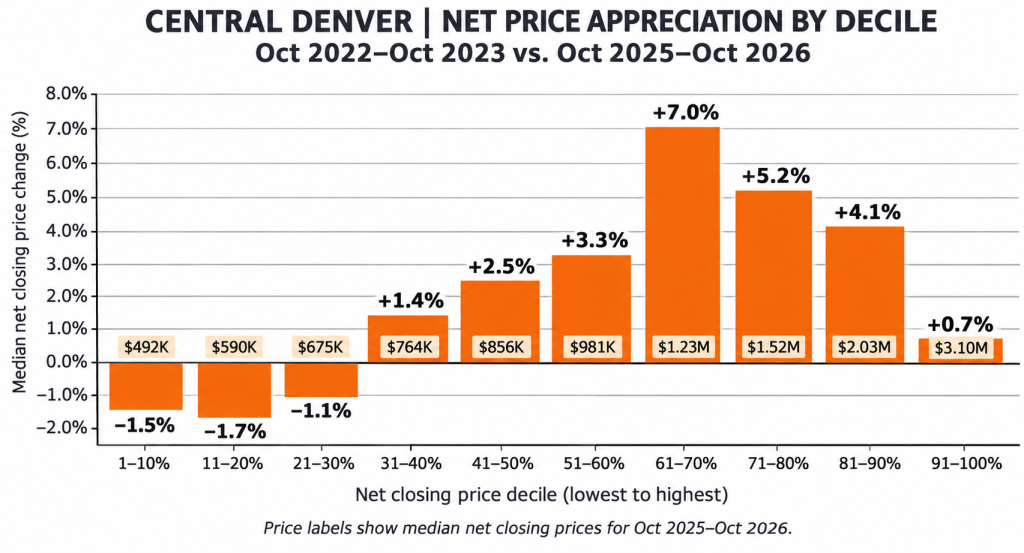
The upper-middle market posted the strongest gains. The 60th–70th percentile, now at a median net price of
$1.23 million, rose 6.96%. The 70th–80th percentile increased 5.17%, and the 80th–90th percentile gained
4.10%. Together, these three deciles, roughly $1.2 million to $2.0 million, outperformed the overall market.
Demand is driven by move-up buyers using equity from prior home sales to meet changing lifestyle needs.
Meanwhile, supply is being suppressed as homeowners are reluctant to give up their low mortgage interest
rates to make a change.
The Lower End Tells a Different Story
The bottom 30% of sales showed small price declines of roughly 1%–2%. Higher mortgage rates are
squeezing buyers with tighter budgets out of the market at these lower price ranges. In addition, these
buyers are more likely to be first-time home buyers who don’t have equity from riding the last decade’s
appreciation wave. Finally, the oversupply of new-construction apartments in Denver is enticing some
would-be buyers to rent at affordable rates rather than buy.
And What About Luxury Homes?
At the very top of the market, growth was limited. The highest-priced 10% of sales, with a median net price of
about $3.1 million, rose just 0.66%. While higher-priced homes are more immune to interest rates, the
disappearance of virtually free money back in 2020 and 2021 is no longer fueling the price appreciation of
years past.
What This Means for Sellers
At the lower end of the market, offering buyers financing options, like interest rate buy-downs, will benefit
your bottom line more than a price reduction.
What This Means for Buyers
At the middle and upper ends of the market, now is a good time to purchase. Seasonally, the competition to
purchase homes, especially higher-priced homes, declines this time of year as schools are in full swing, and
weather is less cooperative.
If you’re considering buying or selling, or know somebody who is, we would be grateful for the opportunity to
discuss. As always, thank you for your business, referrals, and support!